
Some fabrics fail quietly, others fail suddenly. A garment may look fine for months and then show a web of pulled threads, while another may remain smooth until a single moment of force causes a visible rip.
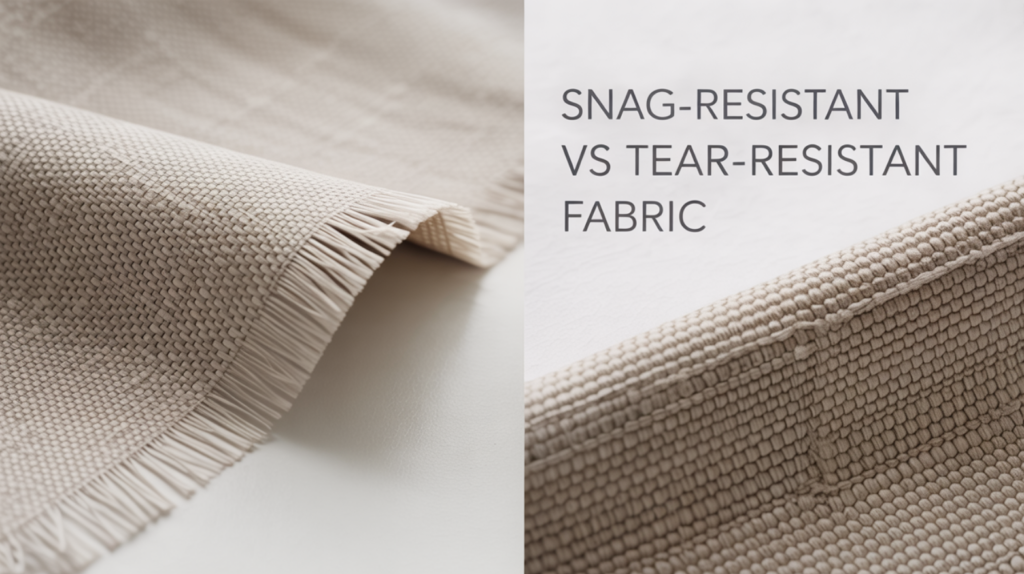
These two types of damage come from very different weaknesses inside the fabric, which is why snag resistance and tear resistance must be understood separately.
What Snag Resistance Really Protects
Snag resistance governs what happens on the surface. When a fabric brushes against sharp corners, textured surfaces, or accessories, the surface threads experience stress. In stable constructions, those threads remain anchored and slide back into place. In weaker ones, they lift, loop, and create visible pulls.
This kind of damage spreads easily. Once one thread is displaced, neighboring fibers lose support, making future snags more likely in the same area. Over time, the fabric’s appearance degrades even if the structure itself remains intact.
What Tear Resistance Handles Instead
Tear resistance addresses internal strength. It measures how much force the fabric can absorb before the yarns break apart completely. When a material is pulled hard, snag resistance no longer matters. At that moment, only the strength of the fiber network determines whether the cloth stretches, holds, or splits.
This explains why some workwear fabrics withstand extreme tension but still develop surface snags, while others look flawless until a single sharp pull opens a visible tear.
Why These Properties Rarely Align
Engineering a fabric for surface stability is not the same as engineering it for tensile strength. A tightly controlled surface may limit snagging but sacrifice flexibility, while a high-strength weave may leave individual threads exposed. As a result, manufacturers often balance these features based on intended use rather than trying to maximize both.
This balancing act becomes especially noticeable when examining materials that naturally attract surface snags, many of which still demonstrate impressive tear strength.
How Real-Life Use Reveals the Difference
Everyday movement produces low-level contact: brushing against desks, chairs, bags, railings, and walls. Over time, this contact determines whether a garment looks aged. Snag resistance governs that slow transformation.
In contrast, tear resistance reveals itself in accidents: catching on a fence, pulling against machinery, or sudden force during activity. At that moment, surface quality becomes irrelevant and raw strength takes control.
For people selecting materials, this difference often becomes clear only after repeated wear, when fabrics either retain their smooth appearance or begin showing constant pulled threads. This experience becomes easier to interpret when learning how snag resistance functions at the fiber level.
Choosing the Right Protection for Your Needs
Clothing worn daily in offices, homes, and public spaces benefits far more from strong snag resistance than extreme tear resistance. In contrast, industrial clothing, outdoor gear, and safety garments prioritize tear resistance even if surface appearance suffers.
Understanding where the fabric will live determines which type of protection matters most.
Many of the materials that tear well under force still struggle with surface pulls, a pattern that becomes obvious when studying which fabrics are naturally more prone to snagging under daily conditions.
Closing Thought
Snag resistance protects the story your fabric tells over time. Tear resistance protects it in moments of force. Both matter, but they solve different problems. When you recognize which threat your fabric faces most often, your material choices become far more satisfying and far less wasteful.