
Blended fabrics are often more prone to snagging because different fibers respond to tension, friction, and stretching in unequal ways. When fibers don’t behave uniformly, the fabric surface becomes less stable and more vulnerable to pulls.
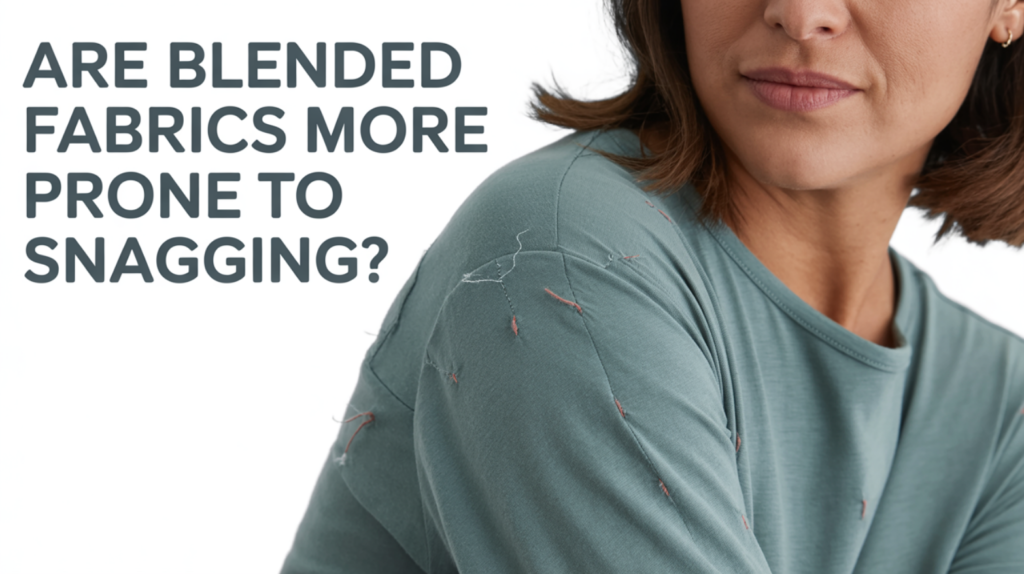
This article explains why blends snag unpredictably, which blends are most at risk, and how blended fabrics compare to single-fiber materials.
1. Different Fibers React Differently to Stress
In blended fabrics, each fiber type has its own properties.
For example:
- Cotton resists pulling but abrades over time
- Wool stretches and rebounds easily
- Polyester is smooth and strong
When these fibers are combined, stress doesn’t distribute evenly. One fiber may stretch while another resists, causing localized thread pulls and visible snags.
2. Blends Increase Yarn Slippage
Blended yarns often allow fibers to slide past each other more easily.
This leads to:
- Uneven tension along the yarn
- Looser surface fibers
- Greater chance of loops or ends pulling free
This behavior mirrors issues seen in knit fabrics, especially when blends are used in knitted constructions.
3. Stretch Blends Are the Most Vulnerable
The highest snag risk appears in stretch blends.
Common examples include:
- Cotton + elastane
- Polyester + spandex
- Wool + nylon stretch blends
Stretch forces fibers to extend and recover at different rates. Over time, this weakens surface stability.
4. Blended Knits Snag More Than Blended Wovens
Construction still plays a major role.
- Blended knits:
High snag risk due to exposed loops and mixed fiber behavior - Blended woven fabrics:
More stable, but still less predictable than pure fibers
This is why blended sweaters snag more frequently than woven cotton shirts, even when fiber quality is high.
5. Blends Often Hide Weak Fibers
Some blends are designed to improve cost or feel, but can mask weaknesses.
A blend may include:
- Strong fibers for durability
- Weak fibers for softness
When the weaker fibers fail, they pull out unevenly, creating snags that look worse than damage in uniform fabrics. This is commonly seen in wool blends, reinforcing why wool and sweaters snag more when blended.
6. Blends vs Delicate Fabrics
While blends can snag easily, they still outperform extremely delicate fabrics.
Compared to:
- chiffon and silk → blends are more durable
- Knit wool → blends may snag more unevenly
- Denim → blends rarely tear cleanly
This places blends in a moderate-to-high risk category depending on construction.
7. Where Blended Fabrics Snag Most
High-risk situations include:
- Repeated friction zones
- Metal hardware contact
- Washing with rough garments
- Stretch stress points
Because blends fail unevenly, snags often look messier and harder to repair than those in single-fiber fabrics.
Final Takeaway
Blended fabrics are more prone to snagging because fiber mismatch creates instability at the surface. The more different the fibers behave, especially with stretch involved, the higher the snag risk.
If snag resistance matters, tightly woven single-fiber fabrics remain the most predictable choice.