Usually, no. A snagged thread should not be your first target with scissors, because the visible loop is often still part of the fabric structure. What looks like a loose piece may actually be a thread that has been pulled out of position but is still doing its job inside the weave or knit. Cutting it too early can turn a repairable snag into a permanent weak spot, which is why the safer approach is to think in terms of fixing fabric snagging rather than trimming the evidence away.
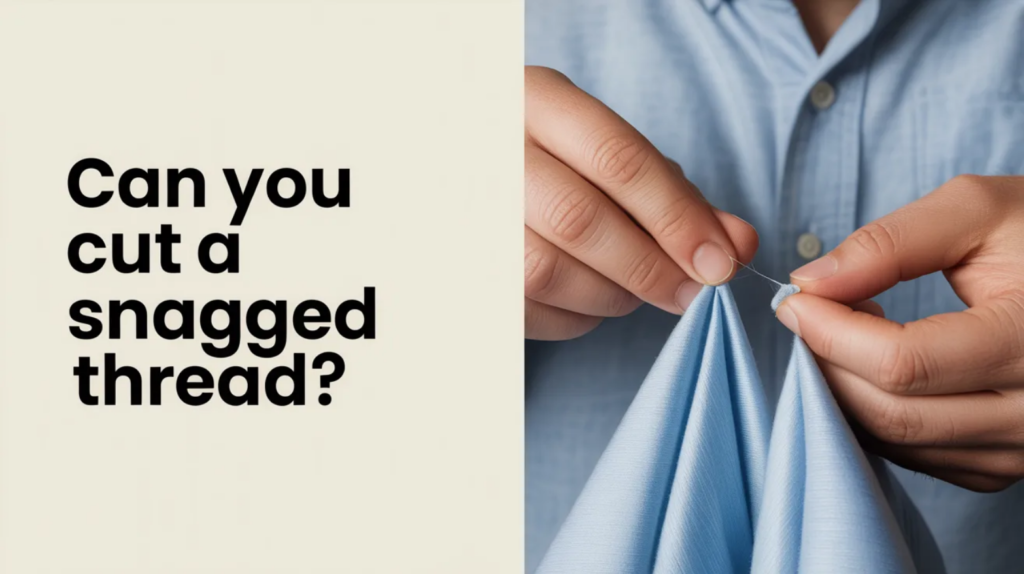
That is the part many people get wrong. The loop looks messy, so the instinct is to remove it. But a snag is often a tension problem before it becomes a damage problem. If you cut first, you lose the chance to work that tension back through the fabric.
Why scissors can make the damage worse
Imagine one thread being dragged slightly out of line while the rest of the fabric stays connected around it. That displaced thread may still be holding the surface together. Once it is cut, the fabric can be left with a tiny broken path instead of a thread that could have been eased back into place. On some garments, that means fuzzing. On others, it means a more obvious mark, a weak point, or even a small opening that grows over time.
This risk is especially high on smooth fabrics, fine knits, delicate woven materials, and anything that already shows surface damage easily. In those cases, cutting the loop may solve the visual annoyance for a moment while creating a longer-term problem underneath.
What to do before deciding anything
Put the garment down on a flat surface and actually inspect the snag. If the thread is still intact and you can see that it has only been pulled outward, there is a strong chance it can be improved without trimming. If the fabric around it is puckered, lined, or slightly distorted, that is another clue that the weave tension has shifted rather than failed completely.
In that situation, the better move is to work the snag gently instead of removing it. If you want the safest next step, start with techniques for removing snags without cutting the thread, because that keeps your options open while the fabric is still recoverable.
Are there any cases where cutting may be acceptable?
There are a few limited cases where trimming might be considered, but they are not the usual starting point. For example, if the thread is already broken, clearly detached, and sticking out in a way that cannot be guided back, a very careful trim may sometimes be the final tidy-up step after you have done everything else. Even then, it should be approached cautiously, because “already broken” and “looks loose” are not the same thing.
Another rare case is a heavily textured fabric where the snag has already been stabilised and the tiniest visible fibre end remains. That is different from taking scissors to a fresh loop on a blouse, dress, knit top, or sweater the moment you notice it.
Fabric type changes the answer
On delicate fabrics, cutting is riskier. Silk, chiffon, satin, fine synthetics, and lightweight knits tend to reveal the consequences quickly. A clipped thread may leave a visible disturbance that catches the light even more than the original snag did. On thicker or more textured materials, the result may be slightly more forgiving, but “more forgiving” still does not mean “safe by default.”
That is why the best rule is not based on impatience. It is based on structure. If the thread may still be part of the fabric, do not cut it just because it is visible.
The mistake people regret most
The most common regret is cutting first and then realising the surrounding area now looks flatter in one place, weaker in another, or slightly open where the fabric used to hold together. At that point, the original loop is gone, so you cannot undo the decision. A small snag that might have been softened or redistributed becomes a permanent alteration instead.
This is also why quick fixes often fail. Snag repair is rarely about making the visible thread disappear instantly. It is more about restoring balance so the fabric surface stops drawing attention to that one point.
If you already cut it
Do not panic. A cut snag does not always mean the garment is ruined. It just means the repair options may be narrower. Leave the area alone for a moment and inspect whether the fabric is opening, fraying, or simply showing a tiny fuzzy end. Sometimes the damage stays mostly cosmetic. Other times, especially on delicate fabrics, the area needs extra care to stop it worsening in wear or washing.
If the garment is valuable, very visible, or made from a fragile material, this is the point where professional help may be the smarter choice.
A better question than “Can I cut it?”
The more useful question is, “Has this thread completely lost its role in the fabric?” Very often, the answer is no. That is why cutting should be the last resort, not the automatic response. The visible snag is annoying, but removing it blindly can create a more serious problem than the one you started with.
Final takeaway
You can cut a snagged thread in some rare situations, but it is usually the wrong first move. Most of the time, the thread is better treated as part of a repair problem, not as loose waste that needs trimming. If the snag is fresh and the thread is still intact, careful handling gives you a much better chance of saving the fabric than reaching for scissors too soon.